
Boise MSA Land Market Report Q3 2026: Commercial Land Sales Rise as Development Activity Becomes More Selective
TOK Commercial Research & Insights | October 2026
Commercial land transaction consideration increased 22% in the Boise Valley, while major industrial projects drove construction permit values higher and residential development maintained a measured pace.
The Boise Metropolitan Statistical Area (MSA) land market continues to attract substantial investment, although the pace and composition of development activity are changing.
According to TOK Commercial’s Q3 2026 Boise MSA Land Market Report, commercial land transaction consideration increased 22% over the preceding 12 months, commercial construction permit values more than doubled year over year, and single-family residential development remained relatively stable through July 2026.
Large industrial projects, continued retail land demand, and shifting residential construction patterns are influencing opportunities across Boise, Meridian, Nampa, Caldwell, Eagle, Kuna, and surrounding communities.
For buyers, sellers, developers, builders, investors, businesses, and government organizations, the latest data offers important insight into where investment is occurring and how land market conditions differ throughout the Boise Valley.
[Download TOK Commercial’s Q3 2026 Boise MSA Land Market Report — PDF]
Boise MSA Land Market Snapshot: Q3 2026
TOK Commercial tracks land transactions, construction permitting, and development activity across Ada and Canyon counties to provide a comprehensive view of the region’s land market.
| Market Indicator | Reported Activity |
|---|---|
| Commercial construction permit value | $865 million |
| Commercial construction permits | 103 |
| Residential construction permit value | $1.2 billion |
| Residential construction permits | 4,234 |
| Commercial land consideration | Up 22% over the preceding 12 months |
| Commercial permit volume | Down nearly 13% year over year |
| Single-family permit volume | Down 5.1% year over year |
| Multifamily permitted units | 694, down from 984 |
| Multifamily permit value | $98 million, down nearly 32% |
Source: TOK Commercial Q3 2026 Land Market Report. Construction permit data through July 2026, sourced from Construction Monitor for Ada and Canyon counties. Commercial land consideration reflects the preceding 12 months.
What do these indicators tell us?
The Boise Valley’s land market is experiencing continued investment alongside more selective development activity.
Commercial construction values have increased substantially, but much of that increase is concentrated in major industrial projects. Meanwhile, retail land continues to attract buyers, single-family construction remains comparatively stable, and multifamily development has moderated.
These distinctions are important when evaluating land values, development opportunities, and investment conditions across individual communities.
Commercial Land Development: Industrial Investment Drives Permit Values Higher
Commercial construction permit value reached $865 million through July 2026, more than double the comparable 2025 level, despite a nearly 13% decline in the number of permits issued.
The primary contributor was Micron Technology’s ongoing investment in the Boise Valley.
Micron-related projects accounted for approximately $540 million in commercial construction permit value, representing 62% of the regional total.
The scale of these projects pushed industrial development to the leading position in both commercial permit volume and value.
This distinction between construction permit volume and permit value is significant. While fewer commercial projects received permits, the magnitude of several major developments substantially increased total investment.
What does this mean for the Boise Valley land market?
The data demonstrates that large-scale industrial investment continues to shape the region’s commercial development environment.
However, the increase in total permit value does not indicate that all commercial property sectors are experiencing equivalent growth.
Excluding Micron-related activity, Meridian continued to lead the Boise Valley in overall development activity.
For landowners, developers, and investors, evaluating permitting trends by property type and submarket provides a more complete picture of underlying market conditions.
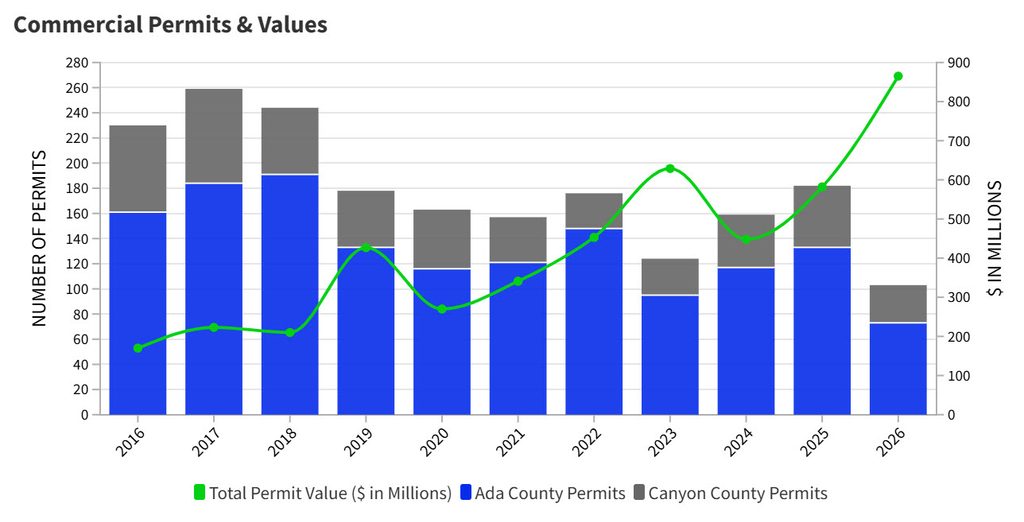
[CHART: Commercial Construction Permits & Values — Q3 2026 Land Market Report, Page 5]
Figure 1. Boise MSA commercial construction permit volume and value. Permit values more than doubled year over year through July 2026, driven primarily by Micron Technology projects, while permit volume declined nearly 13%. Source: TOK Commercial Research & Insights; Construction Monitor, Ada and Canyon counties.
Retail Land Leads Commercial Land Transaction Activity
Commercial land sales provide another important measure of investment demand.
According to TOK Commercial’s research, total commercial land transaction consideration increased 22% compared with the preceding 12-month period.
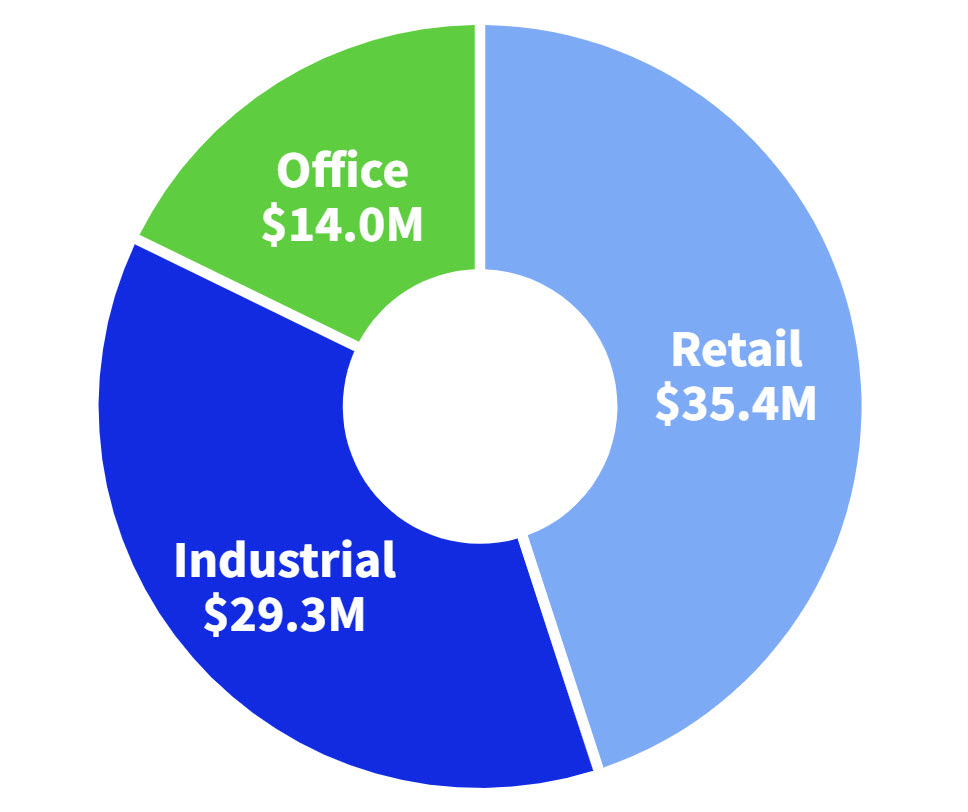
Retail land represented the largest share of commercial land consideration, accounting for 45% of the total.
Commercial Land Transaction Consideration by Property Type
| Property Type | Transaction Consideration |
|---|---|
| Retail land | $35.4 million |
| Industrial land | $29.3 million |
| Office land | $14.0 million |
Source: TOK Commercial Q3 2026 Land Market Report. Transactions from the preceding 12 months.
Retail’s leading position reflects continued demand for commercial development sites serving the Boise Valley’s growing population.
Recent retail construction permitting reinforces this trend.
Notable projects included a $30 million Costco development at Lake Hazel and a $51 million Life Time athletic club at 901 S. Umbria Hills Way.
Office development also contributed to commercial permit values, including a $53 million St. Alphonsus project in Meridian.
Why is commercial land transaction consideration important?
Transaction consideration measures the total reported dollar value of land sales during a defined period.
For buyers and investors, it helps identify where capital is being deployed across different property types.
For sellers, it provides context for current investment activity, although individual property valuations still depend on comparable sales, location, zoning, infrastructure, and development feasibility.
For economic development organizations, the composition of land sales offers insight into the types of commercial uses attracting private investment.
[CHART: Commercial Land Consideration by Property Type — Q3 2026 Land Market Report, Page 5]
Figure 2. Boise MSA commercial land transaction consideration by property type. Retail land accounted for $35.4 million, or 45% of total commercial consideration, followed by industrial land at $29.3 million and office land at $14.0 million. Source: TOK Commercial Research & Insights, preceding 12 months.
Where Are Commercial Land Transactions Occurring in the Boise Valley?
Commercial land transaction activity varies significantly by community.
TOK Commercial’s Q3 2026 research identifies two particularly important geographic trends:
- Meridian recorded the highest number of commercial land transactions in the Boise Valley.
- Nampa led the region in total commercial land acreage sold.
These differences demonstrate why transaction count, acreage, and total consideration should be evaluated independently.
A community with more transactions may not necessarily lead in total acreage sold or investment value.
Recent Boise Valley Land Transactions
TOK Commercial’s report documents recent commercial, industrial, residential, and multifamily land sales across the metropolitan area.
| Property / Location | Acreage | Land Use |
|---|---|---|
| Centrepoint Marketplace | 1.0 | Commercial |
| Star Retail Lots | 3.0 | Commercial |
| 4260 Franklin Boulevard | 4.9 | Commercial |
| 106 Ustick Road | 16.6 | Commercial |
| 12064 Lone Star Road | 40.0 | Commercial |
| 1450 Fargo Avenue | 1.8 | Industrial |
| 5132 Franklin Road | 4.7 | Industrial |
| Pleasant Valley | 42.0 | Industrial |
| TBD Floating Feather Road | 7.0 | Residential |
| 8750 Bogart Lane | 8.0 | Residential |
| 9495 Chinden Boulevard | 28.5 | Residential |
| 2715 Deer Flat Road | 19.7 | Residential |
| 3123 Victory Road | 2.2 | Multifamily |
Selected transactions from TOK Commercial’s Q3 2026 Land Market Report, page 6. Land-use classifications reflect the report’s map legend. These are reported sales, not currently available listings.
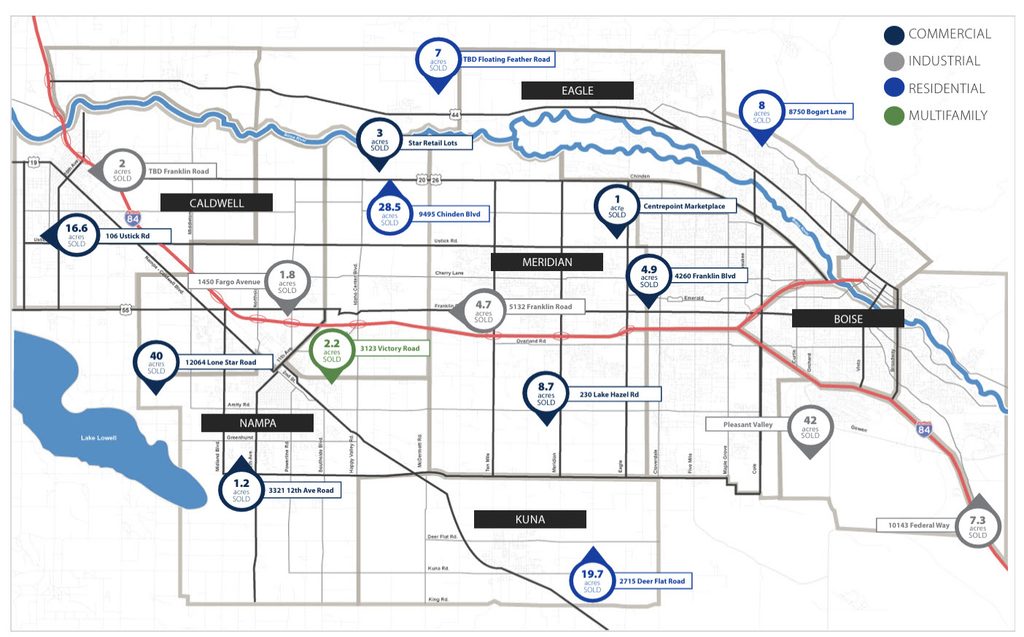
[MAP: Recent Boise Valley Land Transactions — Q3 2026 Land Market Report, Page 6]
Figure 3. Recent commercial, industrial, residential, and multifamily land transactions across the Boise Valley, including Boise, Meridian, Nampa, Caldwell, Eagle, and Kuna. The map illustrates the geographic distribution and acreage of selected land sales. Source: TOK Commercial Research & Insights, Q3 2026.
Why does location-specific land transaction data matter?
Land markets are highly localized.
For example, Meridian’s leadership in commercial transaction count and Nampa’s leadership in acreage sold represent different types of market activity.
Investors evaluating commercial land opportunities should consider not only the number of recent sales but also parcel sizes, land-use classifications, transportation access, utility availability, and development potential.
For municipalities and regional planning organizations, the geographic distribution of land transactions provides additional context for evaluating growth patterns and infrastructure needs.
Related TOK Commercial resources:
- [Explore commercial land for sale in the Boise Valley]
- [View Boise MSA commercial real estate market research]
- [Connect with TOK Commercial’s land brokerage professionals]
Residential Land Market: Single-Family Development Remains Stable
Residential land development maintained a relatively steady pace through July 2026.
Single-family construction permit volume declined 5.1% year over year, while total permit value increased just 2.6%.
Permitted home sizes also increased during the year, with average square footage rising from 2,540 square feet in January to 2,664 square feet in July, approximately a 5% increase.
Meridian and Kuna led the Boise Valley in residential permitting activity.
Home sales strengthen across Ada and Canyon counties
Residential resale activity also increased through July 2026.
According to Intermountain MLS data cited in TOK Commercial’s report:
| Residential Market Indicator | Ada County | Canyon County |
|---|---|---|
| Year-over-year home sales growth | +15% | +9% |
| Median home sale price | $561,000 | $435,990 |
| Year-over-year median price change | Unchanged | +3% |
| Share of sales priced $400,000–$500,000 | 28% | 37% |
The $400,000 to $500,000 price range represented the largest share of home sales in both counties.
For residential land developers and homebuilders, these figures provide context for evaluating housing demand, subdivision opportunities, and potential development strategies.
While single-family permitting has moderated slightly, increasing resale activity and relatively stable home values suggest that residential market fundamentals continue to support development.
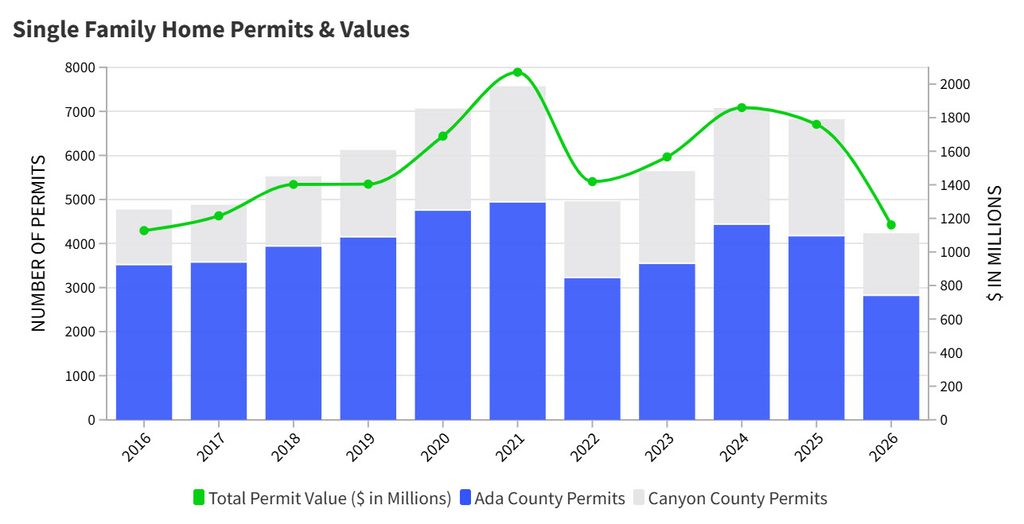
[CHART: Single-Family Units & Permit Values — Q3 2026 Land Market Report, Page 5]
Figure 4. Boise MSA single-family construction permitting trends. Permit volume declined 5.1% year over year through July 2026, while permit value increased 2.6%. Source: TOK Commercial Research & Insights; Construction Monitor, Ada and Canyon counties.
Multifamily Development Slows as Developers Take a More Selective Approach
Multifamily construction activity moderated through July 2026.
The Boise Valley recorded 694 permitted multifamily units, compared with 984 units during the corresponding period in 2025.
Multifamily construction permit value also declined nearly 32% year over year, totaling approximately $98 million.
Meridian remained the region’s leading center of multifamily development, recording 280 permitted units, followed by Caldwell with 200.
These figures indicate that developers are pursuing new multifamily projects at a more measured pace.
What does declining multifamily permitting mean for investors?
Construction permits offer insight into potential future development activity, but they should not be interpreted as a direct measure of current apartment occupancy or rental demand.
For multifamily developers and investors, declining permit activity may signal a changing future supply pipeline.
However, evaluating new projects requires additional analysis of rental rates, vacancy, construction costs, financing, and competing developments.
[CHART: Multifamily Units & Permit Values — Q3 2026 Land Market Report, Page 5]
Figure 5. Boise MSA multifamily construction permitting. Permitted units declined to 694 through July 2026 from 984 during the comparable 2025 period, while permit value fell nearly 32% to $98 million. Source: TOK Commercial Research & Insights; Construction Monitor, Ada and Canyon counties.
What Do Boise Valley Land Market Conditions Mean for Buyers, Sellers, Developers, and Public Agencies?
TOK Commercial’s land market research provides different insights depending on the decisions being made.
Landowners and sellers
The 22% increase in commercial land transaction consideration indicates continued investment in Boise Valley land assets.
Understanding current buyer activity, comparable transactions, zoning, and development feasibility can help property owners evaluate pricing and disposition strategies.
Commercial land buyers and investors
Retail and industrial land accounted for the largest shares of commercial land transaction consideration.
Buyers should assess opportunities using current transaction activity, location-specific demand, infrastructure availability, and potential development uses.
Developers and homebuilders
Relatively stable single-family permitting, improving home sales, and declining multifamily permitting highlight differences within the residential development market.
Understanding these trends can help inform land acquisition, project planning, and construction timing.
Businesses evaluating expansion or relocation
Major industrial investment and continued retail development demonstrate ongoing commercial activity across the Boise Valley.
Businesses evaluating development sites should consider transportation access, utilities, workforce availability, surrounding land uses, and future infrastructure needs.
Municipalities and economic development organizations
Land transactions and permitting activity provide measurable indicators of private investment.
These statistics can support local discussions about community growth, transportation planning, infrastructure investment, and economic development priorities.
Boise MSA Land Market Outlook: Five Indicators to Watch
TOK Commercial’s research suggests that land market performance will continue to vary by property type and location.
Five indicators will be particularly useful in evaluating future conditions:
- Commercial permit values excluding unusually large projects. Separating major industrial investments from broader permitting trends can provide a clearer view of underlying commercial development activity.
- Retail and industrial land transaction consideration. Tracking capital investment by property type will help identify where commercial land demand is concentrated.
- Residential permitting and home sales. Comparing construction activity with home sales and pricing will provide insight into future residential development opportunities.
- Multifamily permit volume and value. These indicators will help monitor changes in the future apartment development pipeline.
- City-level land transaction activity. Monitoring differences among Boise, Meridian, Nampa, Caldwell, Eagle, and Kuna will remain important as development patterns evolve.
The Boise Valley’s land market is not moving uniformly in one direction.
Commercial construction investment remains substantial, retail land continues to attract capital, single-family development is relatively stable, and multifamily construction activity has moderated.
The central takeaway is that significant development opportunities remain across the Boise MSA, but local market knowledge, site selection, and careful evaluation of development feasibility are increasingly important.
Boise MSA Land Market: Frequently Asked Questions
Is commercial land investment increasing in Boise, Idaho?
Yes. TOK Commercial reports that commercial land transaction consideration increased 22% over the preceding 12 months. Retail land accounted for 45% of total commercial consideration.
What is driving commercial construction in the Boise Valley?
Micron Technology’s industrial projects are a major contributor. Micron-related projects accounted for approximately $540 million, or 62%, of the $865 million in commercial construction permit value recorded through July 2026.
Which Boise-area city has the most commercial land transactions?
Meridian recorded the highest number of commercial land transactions in TOK Commercial’s Q3 2026 report. Nampa led the region in total commercial land acreage sold.
Is residential construction slowing in the Boise MSA?
Single-family construction permit volume declined 5.1% year over year through July 2026, while permit value increased 2.6%. These modest changes indicate relatively stable single-family development activity.
Where is multifamily development occurring in the Boise Valley?
Meridian led multifamily permitting with 280 units through July 2026, followed by Caldwell with 200. Across the region, multifamily permitted units declined from 984 to 694 year over year.
What should investors consider when purchasing commercial land in the Boise Valley?
Important considerations include recent comparable land transactions, zoning, development entitlements, utility availability, infrastructure costs, transportation access, and local demand. TOK Commercial’s land market research provides additional context through transaction activity and construction permitting trends.
Explore Boise Valley Land Market Research from TOK Commercial
Understanding the Boise Valley land market requires more than tracking available land or construction activity.
It requires reliable market data, knowledge of local development patterns, and an understanding of how investment activity differs across property types and communities.
TOK Commercial’s Research & Insights team tracks commercial real estate trends across the Boise metropolitan area, producing market reports that support informed decisions by landowners, investors, developers, builders, businesses, and public-sector organizations.
Our research complements the local transaction knowledge and market experience of TOK Commercial’s brokerage professionals.
Whether evaluating a commercial land acquisition, planning a residential development, considering an investment, or studying regional growth, TOK Commercial provides the market intelligence and local expertise to help identify opportunities.
[Download the Complete Q3 2026 Boise MSA Land Market Report]
[Explore Available Boise Valley Land Listings]
[Contact TOK Commercial’s Brokerage Team]
About This Research
Publisher: TOK Commercial Research & Insights
Report: Q3 2026 Boise MSA Land Market Report
Geographic Coverage: Boise metropolitan area, including Ada and Canyon counties
Reporting Period: Construction permitting through July 2026; commercial land transactions over the preceding 12 months
Research Contributors: Taylor Hill, Coralie Mattox, Chiara Kitcher, and Julia Naughton
Primary Data Sources: Construction Monitor, Intermountain MLS, and TOK Commercial land transaction research
Information deemed reliable but not guaranteed. © 2026 TOK Commercial.